Throw pillows are one of the easiest ways to change the look of a living room, but they can also make a sofa look messy, crowded or oddly bare.
Most people are not sure how many to buy, which sizes go together or how to mix patterns without it feeling busy. The good news is that a few simple formulas take the guesswork out of it.
Here is how to arrange throw pillows on a sofa so it looks styled, comfortable and still usable every day.
Start with the Right Sizes
Pillow size matters more than people expect. Too small and they look lost on a deep sofa. Too large and there is nowhere to sit.
- 22 to 24 inch square: best for large or deep sofas and as the back layer
- 20 inch square: the most versatile size for standard sofas
- 18 inch square: good for smaller sofas, chairs and front layers
- Lumbar (about 12×20 or 14×24): adds a horizontal shape and fills the middle
A good rule is to layer from large in the back to smaller in the front.
How Many Pillows Should You Use?
It depends on the size of the sofa:
- Loveseat: 2 to 3 pillows
- Standard three seat sofa: 4 to 5 pillows
- Large sofa or sectional: 5 to 7 pillows
If people actually sit on the sofa every evening, lean toward the lower number.
Easy Pillow Formulas
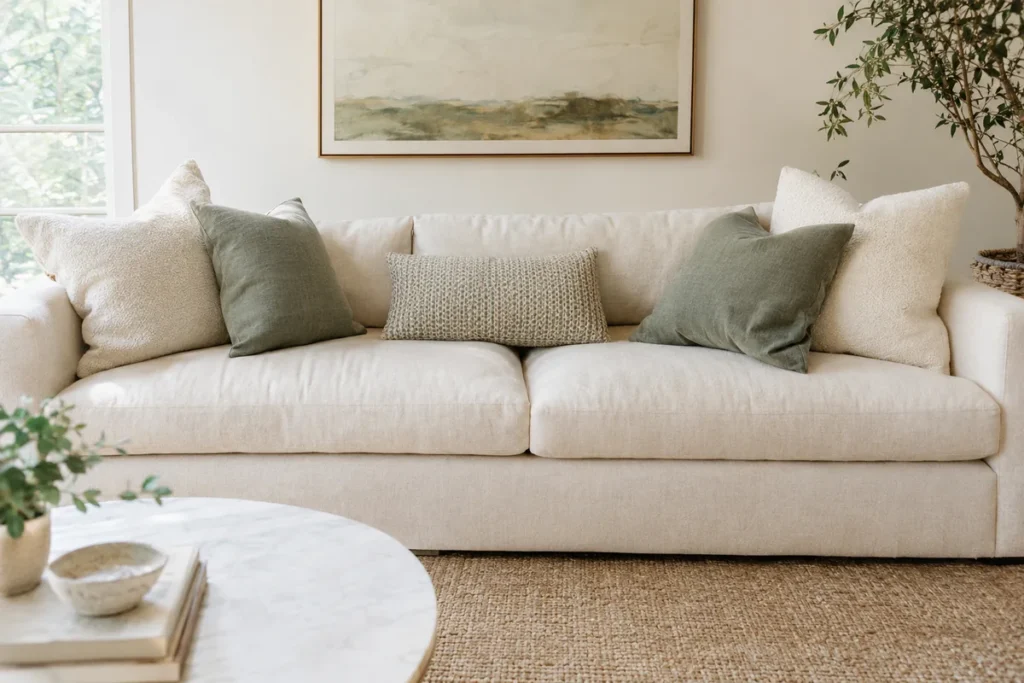
The Symmetrical Four
Two large pillows in each corner and two medium pillows in front of them, mirrored on both sides. This is the most classic, polished arrangement and works on almost any sofa.
The Classic Five Pillow Formula
Use the symmetrical four, then add one lumbar pillow in the center. It fills the gap in the middle and adds a change in shape. This is a favorite for standard three seat sofas.
The Relaxed Asymmetrical Three
Place two pillows on one end (a large one in back, a smaller one in front) and one single pillow on the other end. It feels casual and lived in, which suits smaller sofas and modern spaces.
The Single Lumbar
On a very sleek sofa or a bench style seat, one long lumbar pillow across the center can be all you need.
Sectionals
Treat each corner as its own spot. Put the largest pillows in the corner where the two sides meet, then use pairs at each end. Leave plenty of open seat space between groups.
How to Mix Colors and Patterns
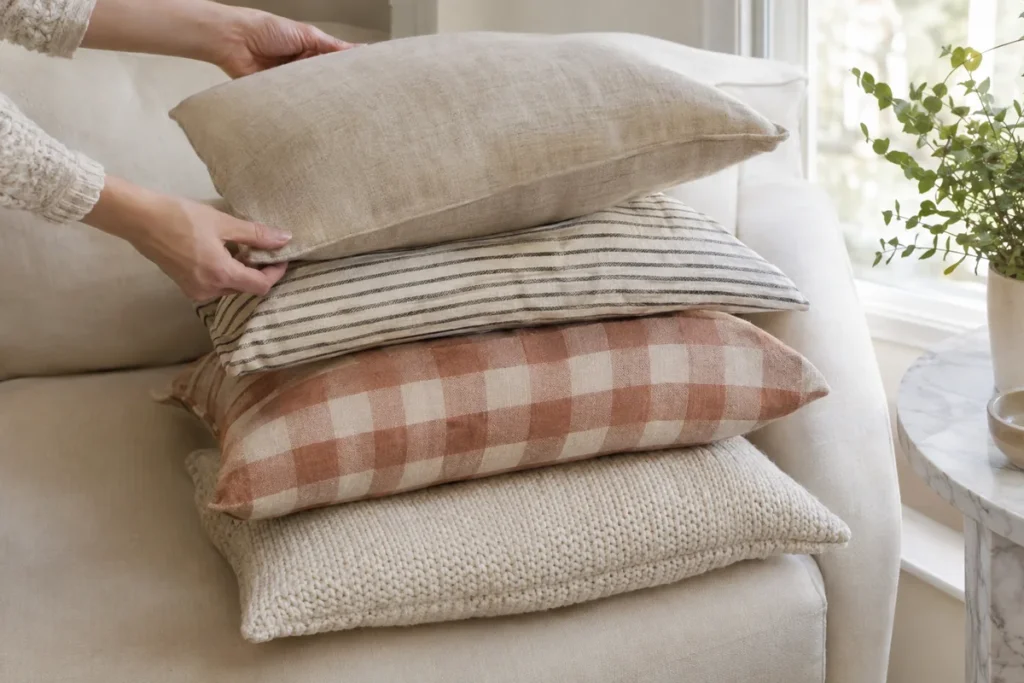
Mixing pillows looks pulled together when you follow a few simple steps:
- Choose a palette of two or three colors. Pull them from your rug, art or curtains.
- Start with a solid. At least one pair should be a plain solid with texture, such as linen or boucle.
- Add a small pattern. A fine stripe, a small check or a tiny print.
- Add a larger pattern. A bigger check, a wide stripe or a soft abstract design.
- Vary the scale. Two patterns of the same size compete. One small and one large work together.
Texture counts as variety too. A neutral sofa with cream boucle, oatmeal linen and a chunky knit can look rich without a single pattern.
Choose the Right Inserts
Inserts make or break the look. Thin polyester inserts go flat quickly and never quite fill the corners of the cover.
- Feather or down blend inserts are soft, hold the classic “chop” and look full.
- Down alternative inserts suit people with allergies and are easy to fluff.
- Size up: buy an insert 2 inches larger than the cover (a 22 inch insert in a 20 inch cover) for a full, plump shape.
Pillow Ideas by Style
The same formulas work for every look. What changes is the fabric and color.
- Modern and minimal: solids only, in two or three close neutrals, with lots of texture. Think cream boucle, oatmeal linen and one charcoal accent.
- Soft and coastal: white, pale blue and sand, with a fine stripe and a linen solid.
- Warm and earthy: terracotta, rust, olive and cream, mixing a small check with a nubby woven solid.
- Classic: a symmetrical arrangement with a karate chop, one floral or paisley pattern and coordinating solids pulled from it.
If you are unsure, start with all neutrals. It is the easiest mix to get right, and you can add one colorful pair later.
Common Pillow Mistakes
- All one size. A row of identical 18 inch pillows looks flat. Mix at least two sizes.
- Too many patterns. Limit yourself to two patterns plus solids.
- Covers that are too big for the inserts. Saggy corners look tired, so size up the insert.
- Ignoring the back cushions. On a deep sofa with tall back cushions, small pillows disappear. Go bigger.
To Chop or Not to Chop?
The “karate chop” in the top center of a pillow gives a tailored, structured look. It works best with feather inserts and in more formal rooms. For a relaxed, modern look, simply fluff each pillow and set it down naturally. Both are fine. Choose the one that fits your room.
Keep Them Looking Fresh
- Fluff pillows daily by pressing the sides together a few times.
- Use removable covers so you can wash them according to the care label.
- Air inserts outside or in a sunny room a few times a year.
- Swap a few covers seasonally (velvet and knit in winter, linen and cotton in summer) and store the rest flat in a bin.
Once you find a formula that suits your sofa, styling becomes quick and easy. Start with good inserts and a simple palette, then let the pillows do the work.
Are you team symmetrical pillows or team relaxed and mismatched? Tell us in the comments.
Quick Questions
Should throw pillows match the sofa?
They should coordinate, not match. Pillows in exactly the same fabric as the sofa disappear. Pick colors from elsewhere in the room so they connect the sofa to the space.
How many throw pillows is too many?
If you have to move pillows every time you sit down, there are too many. For most three seat sofas, four or five is the sweet spot.
What pillow sizes go together?
Pair 22 inch pillows in the back with 20 or 18 inch pillows in front, and add a lumbar pillow for a change in shape.